DNF replaces YUM package manager
In general on RHEL-derived systems use DNF package manager, which replaces YUM package manager. Most commands are very similar in DNF.
In general on RHEL-derived systems use DNF package manager, which replaces YUM package manager. Most commands are very similar in DNF.
Fortran is natively aware of local machine time zone. This simple example shows how to convert character data to numeric values.
Madrigal data repositories give access to numerous types of geospace data spanning multiple decades. One kind of data (3505) is GNSS line of sight (LOS) data. Loading the 10+ GB files is best done by choosing slices of data, typically in time at least. This example Python script may help get started. Plotting the data also requires knowing the location of the receiver and corresponding satellite.
The Madrigal data for GNSS LOS is stored under “Data / Table Layout” as a huge 1D unordered vector of HDF5 compound data. h5py can read slices of the compound data to avoid wasted reads and overusing RAM.
Note that Matlab “h5read()” currently can read only the entire compound dataset as a struct, which may use a lot of RAM.
Fortran derived types are a dual to C / C++ struct. Using Fortran bind(C) attribute of a derived type allows the derived type contents to be passed back and forth with C / C++ using a corresponding struct definition. When modifying previously build Fortran source code that defines a derived type, a fresh build is required. This is because the Fortran module files .mod are not introspected by the build system, and hence the build will fail because there is a conflict between the old and new derived type definitions in the module files.
The solution is to delete the build directory and make a fresh build.
Some users may have a long-ago forked repo that the maintainer would like to track in the main repo as an orphan Git branch. That is, the maintainer does not want to merge the forked repo into the main repo, but would like to track the forked repo as a branch in the main repo.
The branch name “user-feat1” is arbitrary.
git switch --orphan user-feat1
# this allows unrelated history in the branch from the long-ago forked repo

git pull https://github.invalid/user/forked.git user-feat1
# copies the forked repo branch into the main repo branch "user-feat1"

git push -u origin user-feat1
# push the branch to the main repo
This can be useful for the maintainer to make changes to the user code that the user can put back in their repo without the maintainer needing to fork the user repo, which may not be possible on GitHub if the user forked from the maintainer’s repo originally.
The maintainer can get future changes from the user by doing:
git switch user-feat1

git pull https://github.invalid/user/forked.git user-feat1

git pushmacOS hardware requirements increase over time. For computers too old for a supported macOS version, consider installing Linux. Linux normally works very well on Apple computer hardware. Apple maintains a list of no longer supported Apple hardware.
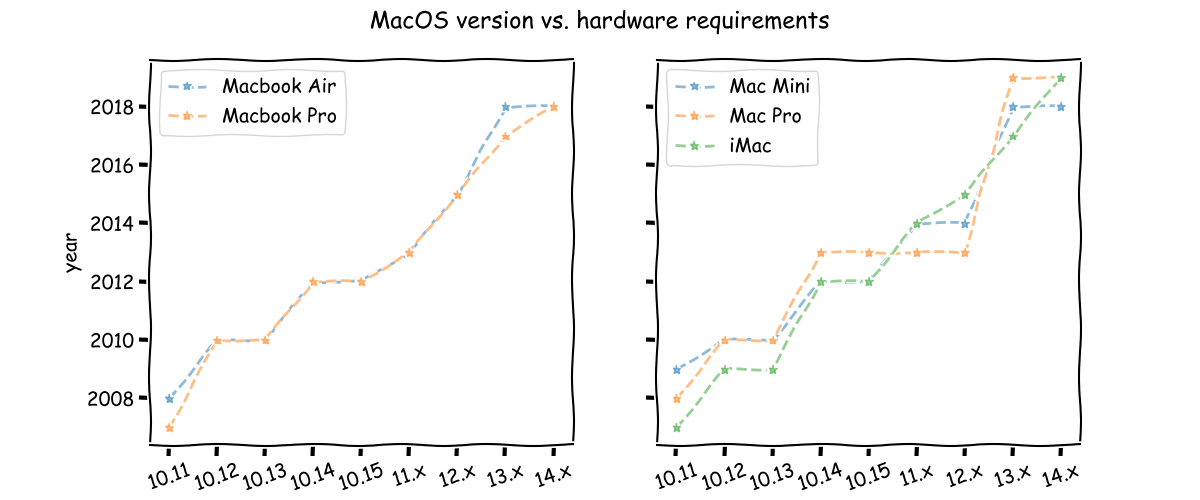
Plotted data sources include Wikipedia and Apple.
Most CMake policies default to “OLD” behavior compatible with prior versions of CMake. cmake_minimum_required(VERSION min…max) automatically sets all the CMake policies to “new” through the “max” CMake version, limited by the user’s CMake version.
Example: project with cmake_minimum_required(VERSION 3.21...3.26) implicitly sets to NEW all CMake policies CMP0143 and older for users with CMake ≥ 3.26.
A user with CMake 3.22 will get NEW for policies CMP0128 and older.
A user with CMake 3.20 will get an error due to the minimum version given as 3.21.
New versions of CMake don’t get the benefits of new behaviors until specifying the new behavior is OK via cmake_minimum_required(VERSION min...max) maximum version number.
CMake gradually deprecates old policies, such that warnings emit when CMakeLists.txt cmake_policy() or cmake_minimum_required() sets the policy to OLD.
For example, CMake 3.28
deprecated CMake 3.20 CMP0120
and older.
Overleaf paid accounts can edit Overleaf LaTeX documents offline and Git push / pull with Git direct to Overleaf. Direct Git access does not require special GitHub permissiongs and works with GitLab, GitHub, Bitbucket, etc.
Once the procedure below is done, you’ll be able to:
git pushgit commit) to Git provider and Overleaf simultaneouslygit push providergit push origingit pullFor simplicity, this procedure assumes the LaTeX project is existing on Overleaf to start. Starting with a project from the Git provider is more complicated since Overleaf cannot accept force push.
Check your current Overleaf LaTeX repo
cd ~/Dissertation
git remote -v
You should see:
origin  https://git.overleaf.com/hash (fetch)
origin  https://git.overleaf.com/hash (push)
Create a new repo Dissertation in the Git hosting provider.
Do not create any README, LICENSE, or .gitignore. Then connect Git provider as origin:
git remote add provider ssh://git.invalid/username/Dissertation

git remote set-url origin --add --push https://git.overleaf.com/hash
git remote set-url origin --add --push ssh://git.invalid/username/Dissertation
Verify setup by
git remote -vshould be like
provider ssh://git.invalid/username/Dissertation (fetch)
provider ssh://git.invalid/username/Dissertation (push)
origin  https://git.overleaf.com/<hash> (fetch)
origin  ssh://git.invalid/username/Dissertation (push)
origin https://git.overleaf.com/<hash> (push)When using TeXLive, the “tlmgr” program allows installing many LaTeX-related packages.
For example, to enable Tikz diagrams via \usepackage{tikz}, install the “pgf” package:
tlmgr install pgfPackages can also be added to TeXLive by the GUI TeX Live Manager. Under Package List select Status: All.
Generally LaTeX bibliographies can use clickable URLs if the LaTeX document specifies:
\usepackage{hyperref}and for software, data, etc. entries that don’t have a specific type in the bibliography style:
@misc{myref1,
author={lorem ipsum},
note={\url{https://github.invalid/user/repo}}
}
Note that HTML percent “%” codes do not work.
The HTML percent must be translated to their ASCII character.
For example, %3A is “:” colon.